Editor’s Note: This is part eighty one of a series of testimonies given by our aboriginal neighbors. We are posting these in an attempt to allow everyone to better understand just how badly Canada has neglected the first nations of Canada. These are the words submitted to the JRP Hearings, to Enbridge and to the Government of Canada.
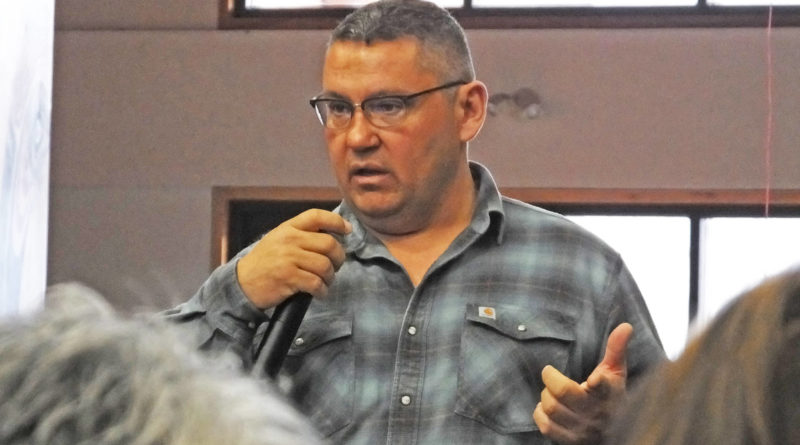
ORAL PRESENTATION BY CHIEF GUUJAAW
CHIEF GUUJAAW: I will provide somewhat of an overview along with my personal history and my — and that of my position that I hold.
I’m Guujaaw. I was born in Massett up Delkatla and I grew up there until I was about 15 years old.
Almost from the time that I could walk I would go with my mother. There’s a point of land just a walking distance of maybe took us 15, 20 minutes to get there where we would go and gather cockles occasionally. And right out in the front we would catch smelts and sometimes we would walk over to the — near where the entrance of Massett is and on the beach there we would gather things like sea cucumbers and sea urchins.
So that, in those early days, was kind of normal for me. It is kind of typical of how our people grew up near and around, playing on the beaches and had developed a relationship with the land from the early days. With my father, I hunted and fished.
I later moved in to Skidegate where I lived with my uncle. He’s now the Chief of Skedans. And I would hunt and trap with him this time of year. And as we did so, we would gather all sorts of seafood, abalone and butter clams and all the good things. And most of that would be brought into the village at the end of our trip.
As — on my own, I travelled around the islands on little boats, little rowboats and canoes and just generally enjoyed the adventure and often brought things to the Elders that were in the village as was proper for a young person to be doing, and in that way I learned stories from the old people and some deeper knowledge of the culture and relationship to the land and the places.
I fished occasionally, trolling, being out on seine boats, being out on food trips to bring back to the village. So each year as it is right now, I go out and mainly to Needan River where I get the sockeye that I need for the year. I often go with my own kids and there’s other people there. Other people go to different rivers.
As well, I usually get enough halibut and other things that I need throughout the months and when they’re accessible. And so through the year, I’m able to feed my family. Probably five times out of the week I feed them from things that we had gathered, seaweeds and clams and the fish that we had put away in various ways.
We prepared them in different ways and so when we serve these foods, we know exactly how they were handled from the time that they were taken from the earth, and that this is the way that I keep in touch with the land. Everybody has their different ways in their times of close intimate contact with the land.
A lot of our people go and pick strawberries out at Rose Spit and out on the North Beach and the time they’re very close to the land. The strawberries were seen as the chief of the plants, the highest one.
Our people trace the genesis of our — and our origins back to — they talk about the times before human beings and how we came to be emerging out of the sea. Our people will — the witnesses will tell you more about that as they come forward.
So that’s the way that we understand that we were — that we came — came about. Our stories go back to before the ice age. We know of the time — we heard the stories of the times when the whole Hecate Strait was dry land and our people lived there, hunted caribou and lived in an entirely different way than they do today.
There’s a lot of the things that were spoken of or referred to as myth amongst our people that over the last 10 or 20 years had been supported by a science as in the fact that the Hecate Strait had been dry during the ice age and that’s where our people lived.
We had stories of grizzly bears that came down and raised havoc amongst the people; we’ve got songs about that and yet, today, there’s no grizzly bears on the island. And in recent years with the research and archaeology on the islands, they found grizzly bear skulls that — in fact, the biggest grizzly bear ever found was on Haida Gwaii.
So the witnesses and myself we’re here to try to make you understand how a culture is born, how it’s developed, and far different than the aspects of civilization which is measured by how far people can be removed from the earth. Our culture is about how close we can be to the earth. And that’s where our songs come from, our language, our dance, all of our crests and all of the material culture is directly from the earth.
For thousands of years our people lived here basically surviving from all that this land provided. In fact, living — it said that this was the highest density of hunter gatherers anywhere in the world, which says something of the wealth of this land and what this land has provided for us.
When the first contacts with the Europeans that occurred, our people were very open to it and if you look at the early logs of the first explorers and settlers, everything was quite easy with our people. They worked fine with them, traded with them and there was no conflict.
And over the years, as cheating came into it and alcohol, the conflict had arisen and as the — there was a big push to get gold out of here. Our people fought and resisted and drove off the gold miners and eventually were — died off on account of small pox, which according to not just our own people but some of the people who had written of what had happened at that time, that it was deliberate.
And following that there was other occurrences that likely weren’t deliberate but at the same time our people suffered from tuberculosis and flus and a lot of other things that were unfamiliar to them.
So when there was — our population was down to 600 people from many thousands, there’s only estimates of what it might have been. It was in excess of 10,000 people, which, to us, seems like a lot, I think, in the — in today’s terms that doesn’t sound like a lot of people, but our people, the 600 people had to basically to survive and to try to adapt to the changes and create a life for ourselves.
And it’s only really in the last 50 to 60 years where we’ve seen the heavy industrial assault on our land with forestry and mining and other things that were occurring. And we knew as we’ve seen those things unleashing the lack of respect for other life, for the salmon bearing streams, for the continuance of fish stocks and all the things that we held dear to us, that we were into a whole different world in our life.
Our culture could potentially be ended by industrialization; our culture could be put away. So where disease and oppression had failed the destruction of our lands did stand to end our culture.
Over the years our people fought, there was blockades, court cases, a lot of different things that occurred, and eventually we had — the laws of the land had changed and processes were set up for dealing with issues of Aboriginal title and for the most part we found that they were not acceptable.
We weren’t going to go through and exchange our title for a treaty which would have been far less — it would have meant surrendering 95 percent of our land to — to the Crown. We haven’t done that.
We have negotiated, and this was after years of blockades, and I think eventually it was such that the economy of this island and the economy of the Province of B.C. started to realize that they needed the First People to be involved. They needed the First People not — they won’t say approval but generally that’s where it goes for most of these things.
And we’ve, over the last few years, sat in a process of reconciliation with both provincial and Government of Canada and while we are able to accomplish some things with the provincial government outside of treaty discussions in exploring whether or not we can reconcile the existence of the Haida people with Canada, we are able to set aside the lands that our people had determined need to be set aside to protect our culture.
This is most of the shoreline of Haida Gwaii, all of the wild lands that remain basically and the cedar. And there’s more protection for the wildlife and for the creeks that salmon come into, as one of our Elders who passed on described the salmon as a creature of the forest because that’s — he is born in the forest and that’s where they die.
But in this century, at this time, if you consider all that’s happened to this earth, all of the destruction, all of the overpopulation, and all of the consumption that’s occurred, how many places on the earth can people still go and get their own food? How many places could they draw upon for fresh salmon or Dungeness crabs that do go to the rich people mainly?
There aren’t that many. And we have seen the trends where basically the Crown industrial interests had seen it as more suitable to grow salmon in pens like chickens and to basically industrialize all of the food that people eat today, and as a consequence, there’s ill health and a lot of medication to counter that.
A lot of the foods that we eat, the seaweed and the plants are showing up now as medicinal plants and some of them have been taken by the pharmaceuticals and used as medicines. These are plants that were used by our people, shown to our people to be useful for various ailments.
We’ve got medicine that fix people with cancer, fix people with AIDS, and these are things, again, that the supernaturals had given us and are very much real as we apply them today.
But these things which are so precious and have been so secret to our people all these years, and we realize we know that we’re not in isolation from the events and things that happen around the world. We’re people who live clearly and, I think, quite comfortably straddled between the worlds.
I think that we’ve been using oil and petroleum products for about as long as anybody else in this world. And we’ve become dependent upon it, as everybody else, all of the goods that we purchase and use out of the stores come by way of ships that are run on diesel and bunker fuel.
But this project that’s proposed right now is — we hear that kind of argument, “you use oil so therefore let them do whatever they want to do to get it, wherever it has to go.” And if you consider that if mankind is dependent upon oil at this time, certainly there is oil to be used and — but at the same time, there’s got to be better consideration for how it’s used and how to best get it to the people that need it.
Like if you consider that the — they bring oil into this country, they bring oil onto this continent and at the same time, want to ship it off, certainly the marketplace, the destination of those — of that oil could pick up the oil if it was — if all of the oil from the tar sands was used domestically for instance, there would be more oil available from the Middle East and Venezuela and these other places from where it’s coming.
Our concern is not just for the oil but for the — in the shipping. Those big ships cannot function properly without a load on it, and so they fill their hulls with water, which is full of other biological things, jellyfish and other life.
Our people have been dealing with introduced species like raccoons that are wiping out — they’re wiping out the seabirds. Rats are wiping out birds and cats. Every species that they’ve introduced — we’ve got knotweed here. When you start adding introduced species into the water, it’s a lot different story. It’s a lot harder to deal with.
We’ve already seen some sea plants that have arrived, and we know that all over the world people are struggling with how to deal with jellyfish, whether it’s in the Mediterranean or the North Sea or Panama, Hawaii, any place where there’s heavy shipping there’s heavy movement of biological — other animals from one place to another in the sea.
As they move around as well there’s — they pump their bilge. We’re out in the range of where those things would be pumped. We’re in an area where the ocean can be quite unforgiving. We know how metal boats can be fatigued on a wild and open sea like that, and all of these things are a great concern of ours.
The eventual spill, we know that — you know, when we get to the point of doing arguments, we’ll talk about the figures that Enbridge is using to say it will be once every 1,500 years. We’re seeing continual spills around the world, collisions of tankers with other boats and we know that eventually if these things come into our water, there will be –
I believe Mr. Matthews has a question of clarification he’d like to ask.
MEMBER MATTHEWS: Thank you, Guujaaw. Thanks for your comments.
In your testimony you mentioned something, you mentioned that you had a reconciliation process occurring, and you mentioned the provincial and federal governments. And am I correct in assuming that you have an agreement with both the federal and provincial governments?
If you could clarify that, it would be great. Thanks.
CHIEF GUUJAAW: I’m glad you asked because we filed a case to prove Aboriginal title, and in discussions with the federal and provincial Crown we agreed that we would sit down and try to see what can be reconciled between us. You know, is there — is there a chance that we could see the day when Aboriginal title is recognized within Canada.
And the discussions, the things that I mentioned, all the areas are protected. We’re basically in joint management over the forestry; we’re in joint management of determining how much logging will occur, where it’ll occur. We’ve already determined where it will not occur.
We looked jointly at what to do with leases, renewals or applications, but with the federal government, basically what we had was their negotiator sat there with no mandate to negotiate so we just basically have given them notice that we’re not going to proceed any more with that.
The process now is we’ve given them notice. They have — there’s a four-month period before we go into the Courts and set a trial date. But basically, the federal government has not done anything.
MS. WILLIAMS-DAVIDSON: Guujaaw, I believe you also wanted to speak about the co-management agreement with the Government of Canada, just prior to the reconciliation process.
CHIEF GUUJAAW: There were a couple of agreements that we made with the federal government before we entered into the process or it is done kind of separately and it is one — one is joint management of the Gwaii Haanas area, in which case we basically agreed to disagree on ownership but we agreed that there’s a need to look after those lands and the agreement is around management.
It’s a management agreement where we set up equal numbers of federal and Haida people to work together in management on all decisions.
That agreement was about 25 years ago and, more recently, we made a similar agreement for a marine component around it that goes out about five miles, and it’s also under joint management.
And there’s one other agreement that was made. It’s for the Sgaan kiinghlas — that’s the Bowie Seamount — which is about 100 miles off the west coast of Haida Gwaii, and it’s a marine protected area. There’s some lesser degree of fishing than there had been. There’s some interest in the black cod, but generally it’s set up to look after that. It’s a very rich and important seamount out there.
I think those were also evidence filed with the Panel.
JLS ……For What It’s Worth